Preparing for an AWS Startups or ISV Account Executive interview
Some AWS sales teams focus on startups, others on ISVs. ISVs are independent software vendors: companies that build and sell their own software, often as SaaS. The interview still runs on the Leadership Principles, but the stories that land are different. Buyers are technical and deals can move fast. Much of the value comes from helping the customer grow their own business.
Team names, segments and programmes change over time. Check the exact scope of the role with your recruiter.
What's different about selling to startups and software companies
- Founders and engineers buy. The decision maker is often a founder or CTO. They will test whether you understand their product. Credibility comes from curiosity and good questions, not a pitch deck.
- Speed matters. A startup can go from first call to production in weeks. Interviewers want to hear that you can move at the customer's pace and qualify quickly.
- Spend grows with the customer. Early revenue is often small. The job is to back the right companies early and grow with them. So you need judgement about where to spend your time.
- Selling with the customer as well as to them. Software companies sell to their own customers. So conversations often cover co-selling, partner programmes and cloud marketplaces such as AWS Marketplace.
- A wider ecosystem. Startup teams often work with venture capital firms, accelerators and incubators to find and support companies.
The stories that land
| Story | Principles it usually proves |
|---|---|
| You closed a deal quickly with a founder or small team | Bias for Action, Customer Obsession |
| You won over a technical buyer who didn't want a sales pitch | Earn Trust, Learn and Be Curious |
| You chose which early-stage accounts to back, and were right | Are Right, A Lot; Think Big |
| You helped a customer sell more of their own product | Customer Obsession, Deliver Results |
| You worked with a partner or marketplace to close or grow a deal | Earn Trust, Invent and Simplify |
| You stopped spending time on an account that wasn't a fit | Frugality; Are Right, A Lot |
| You ran a large book of small accounts without dropping any | Ownership, Dive Deep |
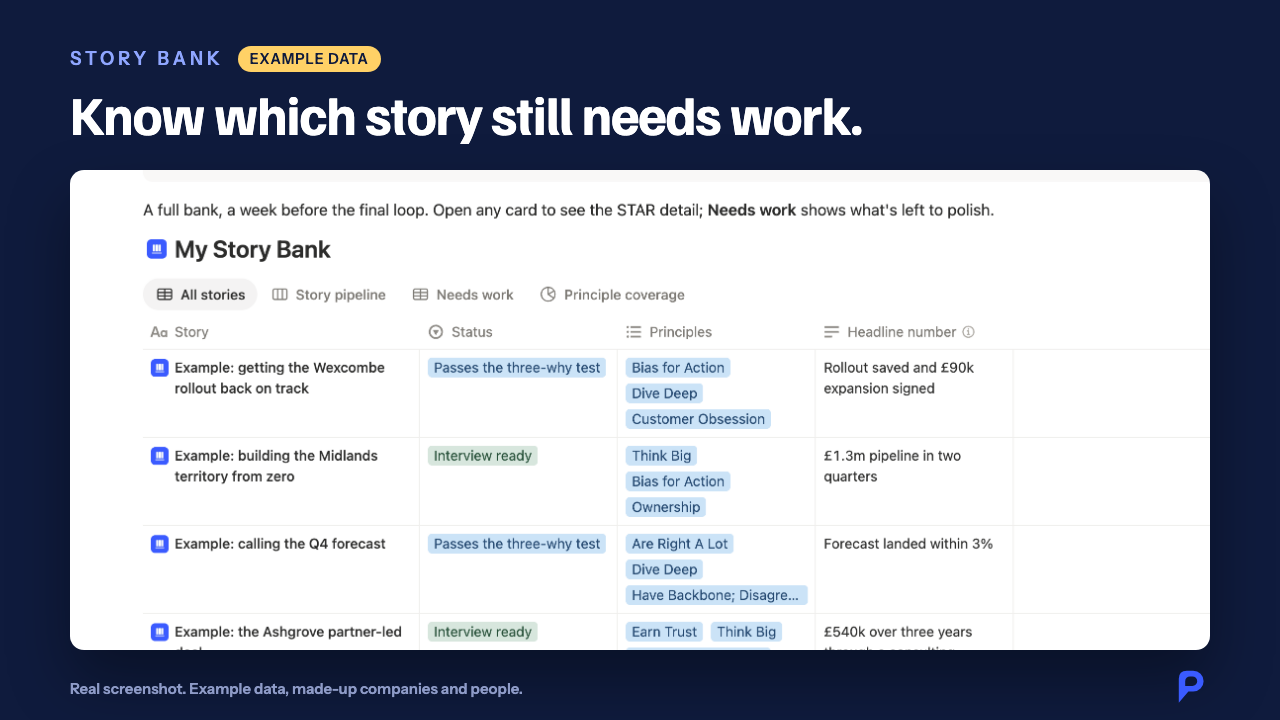
See inside
Know the motions in plain English
You don't need to know every programme in depth. You should be able to explain each of these in a minute:
- How SaaS companies make money: recurring revenue, churn and gross margin. And why cloud costs affect all three.
- Co-selling: a software company's sellers and a cloud provider's sellers working the same customer together.
- Marketplaces: why a software company might list its product there. And how that can make buying simpler for its customers.
- Startup programmes: AWS publishes its startup and partner programmes on its own website. Read them before the loop, as the details change.
Question patterns to expect
- Tell me about a time you sold to a technical founder or CTO.
- How would you decide which startups in a large territory to spend time on?
- Tell me about a deal you closed much faster than usual. What made it possible?
- Tell me about a time you helped a customer grow their own revenue.
- Tell me about a time you worked with a partner to win a deal.
- A promising customer is about to run out of money. What do you do?
A one-week prep plan
Days 1 and 2: build your story bank
Write 10 to 15 real stories as STAR, with a number in each result. Include at least three fast-moving deals and two with technical buyers.
Day 3: learn the customer's world
Pick three startups or software companies you admire. Work out how each makes money and how it might use the cloud. Then practise a 60-second explanation of SaaS metrics.
Day 4: partners and marketplaces
Prepare one story about selling with or through a partner. Add plain-English explanations of co-selling and marketplaces.
Day 5: territory plan
Sketch how you'd prioritise a book of hundreds of accounts: funding stage, growth signals, technical fit. Be ready to talk it through.
Day 6: pressure-test
Ask "why?" three times at every step of each story. Fix any answer that relies on "we" instead of "I".
Day 7: plan the loop
Pick lead stories for each round and prepare questions to ask. Then write a one-page cheat sheet for the day.
Test one of these stories free.
Questions
What is an ISV?
An independent software vendor. That's a company that builds and sells its own software, often as SaaS. ISV-focused sellers help these companies build on the cloud. They often help them sell to their own customers too.
How is an AWS Startups AE interview different from a standard AE interview?
The format and Leadership Principles are usually the same. The stories lean towards fast deals and technical founders. They also cover choosing which early-stage accounts to back and growing spend over time.
Do I need startup experience for an AWS Startups sales role?
It helps but isn't always required. Stories about fast deals, technical buyers, high-volume territories or small-company customers can show the same skills.
Related guides

Greenfield AE interview prep
New-logo stories and how to prove you can build pipeline from nothing.
The AWS Account Executive interview
How the loop works, what it tests and a one-week prep plan.

Solutions Architect interview prep
Discovery, the whiteboard round and the customer stories you need.
Turn this into a prep plan you can actually follow
A Notion workbook for AWS sales interviews. A story bank scores your stories as you write them. You also get 29 question patterns mapped to Amazon's 16 Leadership Principles. It adds a planner for every round and a day-of cheat sheet. £15, one payment, plus VAT for UK and EU buyers.
Principled Pitch is independent and has no connection with Amazon or AWS. Amazon publishes the official Leadership Principles on its careers site.