SDR comp plan examples: five structures, one rep, the maths side by side
Every SDR comp plan pays about the same when a rep hits exactly 100% of quota. The differences show up in the unusual months. In one, a rep books lots of meetings that go nowhere. In another, they book fewer meetings that turn into real pipeline. In those months the plan shows reps what you value. To choose a structure, run the same rep through each option. Then see who gets paid what.
SDR (sales development representative) and BDR (business development representative) are the same job at most companies. Everything here applies to both.
Only need pay and outreach? The SDR Toolkit is £12.99 + VAT.Get the playbook
The common setup
To compare like with like, every example below uses the same numbers. They are illustrative.
| Item | Value |
|---|---|
| OTE | £50,000: £35,000 base and £15,000 variable (70:30) |
| Monthly variable at 100% | £1,250 |
| Monthly quotas | 10 held meetings, 5 accepted opportunities (SQOs), £150,000 of sourced pipeline |
| Accelerator tiers | 1.0x up to 100% of quota, 1.5x from 100% to 150%, 2.0x above 150% |
The Bridge Group's 2025 SDR report puts the median split at 68:32. 78% of its respondents are in North America. Our estimate is that 70:30 is a common split in UK plans. Our SDR and BDR compensation plan guide covers the benchmarks behind it.
The five structures
| Plan | What variable pays on |
|---|---|
| A: Meetings only | 100% on held meetings |
| B: SQOs only | 100% on opportunities accepted by the AE |
| C: Blend | 70% on held meetings, 30% on SQOs |
| D: Pipeline value | 100% on the value of SDR-sourced opportunities at acceptance |
| E: SQOs with a closed-won kicker | 85% on SQOs, 15% on closed-won deals the SDR sourced, paid when they close |
Month 1: lots of meetings, little pipeline
Our rep, Sam, works at an invented company called Harbour Grid Analytics. Sam has a busy month: 13 held meetings (130%). But there are only 4 SQOs (80%) and £105,000 of pipeline (70%). None of Sam's earlier opportunities closed this month.
| Plan | Payout | How it is worked out |
|---|---|---|
| A: Meetings only | £1,812.50 | £1,250 for the first 100%, plus 30% of £1,250 at 1.5x (£562.50) |
| B: SQOs only | £1,000.00 | 80% of £1,250 |
| C: Blend | £1,568.75 | Meetings: £875 x 1.45 = £1,268.75. SQOs: £375 x 0.8 = £300 |
| D: Pipeline value | £875.00 | 70% of £1,250 |
| E: SQOs with kicker | £850.00 | SQOs: 80% of £1,062.50. Kicker: nothing closed |
Month 2: fewer meetings, much better pipeline
The next month Sam focuses on better-fit accounts. The result is 9 held meetings (90%), 7 SQOs (140%) and £240,000 of pipeline (160%).
| Plan | Payout | How it is worked out |
|---|---|---|
| A: Meetings only | £1,125.00 | 90% of £1,250 |
| B: SQOs only | £2,000.00 | £1,250 plus 40% of £1,250 at 1.5x (£750) |
| C: Blend | £1,387.50 | Meetings: £875 x 0.9 = £787.50. SQOs: £375 x 1.6 = £600 |
| D: Pipeline value | £2,437.50 | £1,250, plus 50% at 1.5x (£937.50), plus 10% at 2.0x (£250) |
| E: SQOs with kicker | £1,700.00 | SQOs: £1,062.50 x 1.6. Kicker: nothing closed yet |
See inside
What the two months tell you
Put the months side by side to see what each structure pays for.
| Plan | Month 1 (volume) | Month 2 (quality) | What Sam learns |
|---|---|---|---|
| A: Meetings only | £1,812.50 | £1,125.00 | Book as many meetings as possible |
| B: SQOs only | £1,000.00 | £2,000.00 | Only meetings that sales accepts count |
| C: Blend | £1,568.75 | £1,387.50 | Volume pays, quality helps a little |
| D: Pipeline value | £875.00 | £2,437.50 | Chase big accounts |
| E: SQOs with kicker | £850.00 | £1,700.00 | Quality pays, and closed deals pay later |
Plan A pays most for the month sales valued least. Plan D rewards the month with the most pipeline, but it swings hard. It also depends on deal values that are easy to inflate at acceptance. Plan B and Plan E reward quality consistently. Plan C still pays more for the volume month. At 70:30, the meetings measure dominates. If your AEs complain about meeting quality on a 70:30 blend, this may be why.
Which structure fits which team
- Meetings only (A): new SDR teams and short sales cycles. It also suits intro meeting models where the AE qualifies. Pair it with a strict definition of a held meeting.
- SQOs only (B): teams with a written SQO definition and an AE acceptance deadline. The deadline stops reps waiting.
- Blend (C): a safe default while definitions settle. Consider moving to 50:50 or 30:70 towards SQOs once AE acceptance is reliable.
- Pipeline value (D): mature teams with consistent deal sizing. Add a rule that value is set at acceptance and reviewed by the AE.
- SQOs with kicker (E): longer cycles where SDRs should care what happens after handover. Keep the kicker small, because the SDR does not control the close.
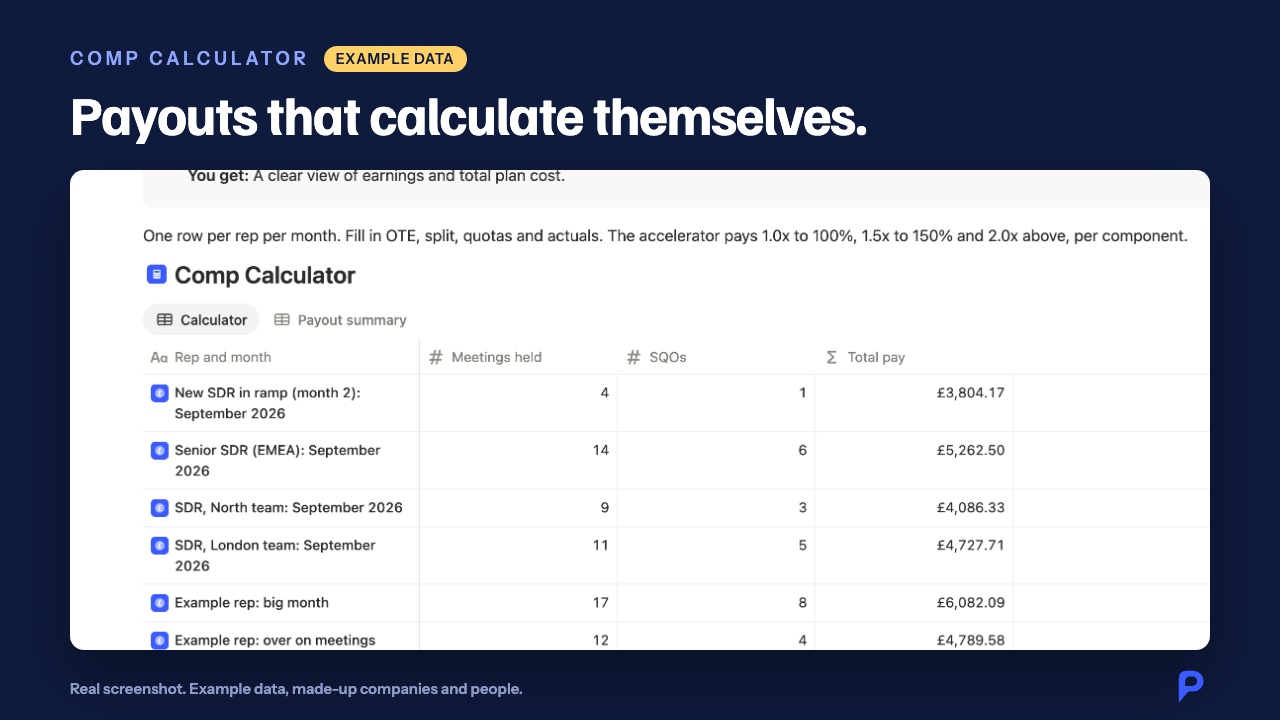
Whichever you choose, model it on last quarter's real numbers before launch. Run each rep through the new plan. Check that your best rep earns clearly more than the median. Check that the payouts match the behaviour you want. Our free SDR comp plan calculator uses the same accelerator tiers as these examples.
Get the quota right first
None of these structures work if the quota is wrong. The Bridge Group's 2025 report found 60% of SDRs at quota. Most reps will read a plan that only pays well above 100% as a pay cut. Build the quota backwards from the pipeline your AEs need. Then check it against the medians in our SDR and BDR KPIs and benchmarks guide.
Want the comp plan, meeting and SQO definitions and AE acceptance rules in one place? The SDR Programme Playbook (£29 + VAT) is a Notion workspace you can duplicate and adapt.
Next step: take your preferred structure into the free comp calculator for Notion.
Sources
Questions
What is the most common SDR compensation structure?
A base salary of around 70% of OTE. Variable pay goes on held meetings, accepted opportunities or a blend of the two. The Bridge Group's 2025 report puts the median split at 68:32. 78% of its respondents are in North America.
Should SDRs be paid on meetings or opportunities?
Meetings give fast feedback and suit new teams. Opportunities accepted by the AE reward quality. Start with a blend if you are unsure. Move weight towards opportunities once definitions and AE acceptance are reliable.
Should SDR comp include closed-won revenue?
Only as a small kicker, if at all. The SDR does not control the close. In long sales cycles, the payment arrives months after the work.
How do accelerators work in an SDR comp plan?
They raise the pay rate above quota. In these examples, the first 100% pays at 1.0x. Attainment from 100% to 150% pays at 1.5x. Anything above 150% pays at 2.0x.
How do I choose between comp plan structures?
Run your last quarter's real results through each option. Pick the structure that pays most in the months your sales team valued most.
Also: SPIFF and contest ideas, commission clawback in the UK, SDR manager compensation plan.
Related guides

SDR and BDR comp plans
OTE benchmarks for the UK, US and Europe, and how to design the plan.
SDR comp plan calculator
Model payouts with accelerators before you launch the plan.
SDR and BDR KPIs
What to measure, and 2024-2025 benchmarks to sense-check against.
SDR draw during ramp
Recoverable and non-recoverable draws compared on one rep.

SDR comp plan template
Six fields, a worked example and a test before launch.
Turn this into a programme you can run
14 Notion modules and 6 working trackers for SDR leaders. KPI library, comp calculator, cadence builder, interview scorecard, tool scorecard and a 90-day roadmap. £29, one payment, plus VAT for UK and EU buyers.
Treat benchmarks as starting points. Tune them to your market, deal size and sales cycle. Every figure shows its source and year.