STAR method for sales interviews: example deal stories that work
STAR stands for situation, task, action and result. In a sales interview it's how you turn "I'm a strong closer" into evidence. Sales stories often fail in two places. The action is all "we", and the result has no number. Below are the shape and three worked examples. The examples are made up, so swap in your own deals. Then there's a checklist to score your own stories.
The STAR shape for a sales story
| Part | What to say | Rough time |
|---|---|---|
| Situation | The account, its size and why it mattered | 15 seconds |
| Task | Your goal or number, in one line | 10 seconds |
| Action | Three or four things you did, and why you chose them | 60 to 75 seconds |
| Result | A number, plus what you learned | 15 to 20 seconds |
These timings are a rule of thumb. The action gets most of the time, because that's the part the interviewer scores.
Example 1: a new-logo win
Situation: "A 400-person logistics firm in my territory had ignored our outreach for over a year."
Task: "I needed two new logos in Q3 to hit my number. This was the largest target on my list."
Action: "I noticed their new operations director had joined from one of my customers. So I asked that customer for an introduction. I ran discovery on missed delivery windows. That was the problem the director had been hired to fix. I built the business case with their finance lead rather than for them. I mapped the four people who had to sign off. I met each one before the proposal went in."
Result: "It signed in 11 weeks at £85K first-year value. That was the biggest new logo in my team that quarter. I now ask every champion who in their network has changed jobs."
Example 2: a deal you lost
Situation: "A £60K expansion with an existing customer went to a cheaper competitor."
Task: "I owned the account and the forecast for it."
Action: "Looking back, I'd worked through one champion. I never met the person who controlled the budget. When finance pushed back on price, I had no relationship to defend the value. Afterwards I changed my process. No proposal goes out on a deal above £30K until I've met at least three stakeholders. One of them must be the budget owner."
Result: "Over the next two quarters I won four of my six deals above £30K. In the half before, I won two of six. I still use that rule."
Interviewers ask for a loss to test ownership, so name your part in it plainly.
See inside
Example 3: a forecast that slipped
Situation: "I had a £120K deal in commit for quarter-end."
Task: "Land it, or call it honestly early enough for my manager to plan around it."
Action: "Two weeks out I found their legal team hadn't seen the contract. I told my manager that day and moved the deal to best case. Then I pulled forward two smaller deals that were ready to sign."
Result: "I finished the quarter at 97% instead of a surprise miss. The big deal closed three weeks later. Since then I confirm the buyer's contract process before a deal goes into commit."
Score each story before the interview
- ☐ Actions use "I", not "we".
- ☐ The result has a number: revenue, a percentage, days saved or pipeline created.
- ☐ It takes about two minutes out loud.
- ☐ It survives three "why?" follow-ups at every step.
- ☐ It ends with what you learned or would do differently.
- ☐ Every number is one you'd be happy to have checked.
- ☐ Customer names are left out ("a 400-person logistics firm").
Build a bank of lines
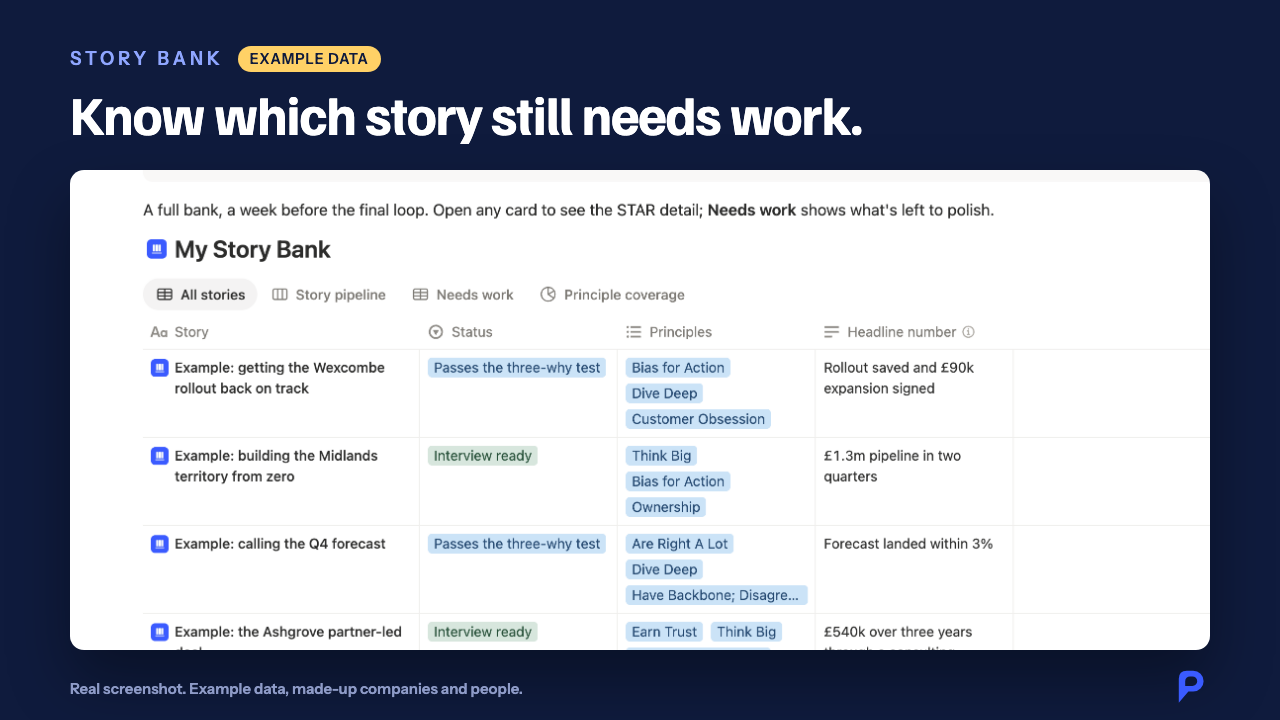
Prepare 8 to 12 real stories so you always have a spare. Between them, cover a new-logo win, an expansion, a loss and a slipped forecast. Add a disagreement, a mistake, a process you improved and someone you helped. Tag each story with the themes it proves. Then practise picking the right one for a question in a few seconds.
The common Account Executive interview questions map neatly onto this list. For AWS interviews, tag each story to the Leadership Principles instead. Aim for at least two stories per principle.
Questions
What is the STAR method in a sales interview?
A way to structure answers to behavioural questions. The situation, your task, the actions you personally took and the result, ideally with a number. In sales, it turns claims about your selling into evidence.
How long should a STAR answer be?
About two minutes out loud, with most of that time on the actions you took. Keep the situation and task short, and end on a measurable result.
Can I use a lost deal as a STAR example?
Yes, and you'll often be asked for one. Own your part in the loss and explain what you changed. Use the result of that change, with evidence, as the R.
Also: sales role play interview, mock cold call interview, why did you leave your last sales job, free story check.
Related guides
Account Executive interview questions
The common questions, what each one tests and how to answer well.
Leadership Principles for sellers
What each of the 16 principles tests in a sales interview.

Greenfield AE interview prep
New-logo stories and how to prove you can build pipeline from nothing.
Turn this into a prep plan you can actually follow
A Notion workbook for AWS sales interviews. A story bank scores your stories as you write them. You also get 29 question patterns mapped to Amazon's 16 Leadership Principles. It adds a planner for every round and a day-of cheat sheet. £15, one payment, plus VAT for UK and EU buyers.
Principled Pitch is independent and has no connection with Amazon or AWS. Amazon publishes the official Leadership Principles on its careers site.