Free SDR training: a 4-week plan you can run with no budget
You can train an SDR team with no budget. You need an hour a week of structured practice and a library of good calls. You also need a manager who measures whether anything changed. Your best material is what the team already produces. That means recorded calls, emails that got replies and the objections reps hear every day. This guide gives you a four-week plan built from that material. It adds the free outside resources worth using and a simple check on whether it worked.
SDR (sales development representative) and BDR (business development representative) are the same job at most companies. Everything here applies to both.
Only need pay and outreach? The SDR Toolkit is £12.99 + VAT.Get the playbook
Why train on your own calls
Generic sales courses teach generic buyers. Your reps sell one product to a known set of roles. They repeat the same few conversations hundreds of times a month. Training built on your own calls is specific, cheap and ready to use the same day. It also gives the team a shared language. Once the team has scored ten openers together, everyone knows what a good one sounds like.
Use outside resources for ideas and frameworks. Use your own calls for practice.
Before you start: build three free assets
- A call library: ten to fifteen recorded calls. Label each one good opener, handled objection, booked meeting or lost it. Most calling and conferencing tools can record. Check your consent and recording rules first.
- An objection bank: every objection the team heard in the last month. Add the two best responses anyone has tried. Ask the reps to write it. It takes 30 minutes.
- A scoring rubric: five lines, each scored 1 to 3. The lines are research, opener, discovery, objection handling and next step. Use the same rubric in every session and in 1:1s.
The four-week plan
Run one 45-minute session a week, same day and time, plus 15 minutes of individual practice. That is about four hours of each rep's month.
| Week | Theme | Session (45 minutes) | Practice before next week |
|---|---|---|---|
| 1 | Research and relevance | Score three openers from the library against the rubric. Agree what "relevant" means for your buyer. | Write a two-line reason for calling for ten target accounts |
| 2 | Cold call opener and objections | Role-play in pairs using the objection bank. Rotate partners every ten minutes. | Record one real call using the new opener; bring it next week |
| 3 | Email and sequences | Review five replied and five ignored emails. Rewrite one weak email as a team. | Rebuild one live sequence step and track replies |
| 4 | Discovery and handover | Role-play the first five minutes of a meeting. Practise writing the handover note. | Write handover notes for the next three meetings booked |
Repeat the cycle every quarter with new calls. New hires join the next cycle as part of their ramp. Our SDR onboarding checklist shows where it fits.
How to run a role-play
- Use real scenarios. Give a named target role, a real objection from the bank and a time limit.
- Score with the rubric and name the line. For example: "Opener 2 out of 3: relevant, but went on too long."
- Keep the observer busy. In groups of three, one rep plays buyer, one sells, one scores.
- Finish with one change. Each rep leaves with one thing to try on real calls this week.
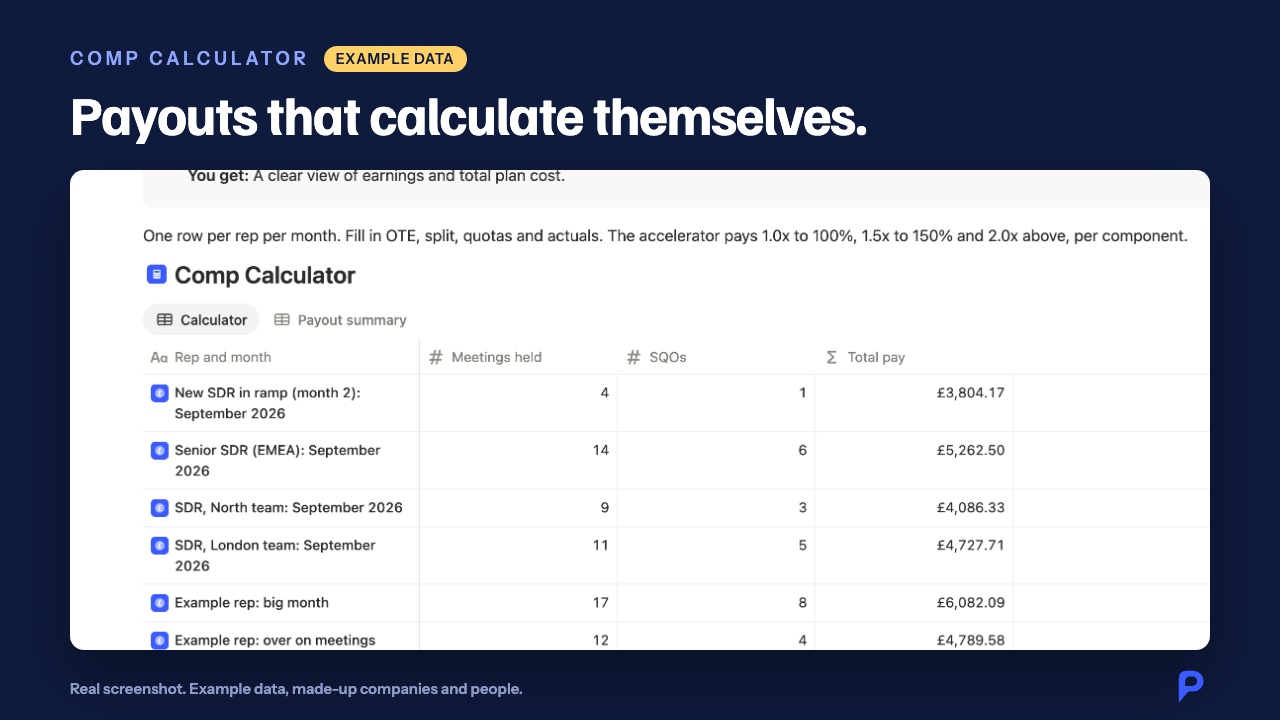
See inside
Free resources
All of these were free to access when we checked in October 2026. Some ask for an email address.
- The Bridge Group, SDR Models, Motions and Metrics (2025 edition). A research report on SDR teams, published every two years. Use it for benchmarks on quota, activity, ramp and pay.
- Gong Labs blog. Research articles based on recorded sales calls. Use it for evidence on openers, talk time and call timing.
- HubSpot Academy, Inbound Sales course. A free online course with a certification. It gives new reps an introduction to prospecting and qualifying.
- 30 Minutes to President's Club podcast. A free sales podcast with short cold calling episodes. Use it for opener and objection ideas in week 2.
- Our free guides. Principled Pitch guides on SDR KPIs, 1:1s and onboarding. Use them for the manager-side structure of the programme.
Use one outside resource per week at most. Spend the rest of the hour on practice.
How to tell if the training worked
Pick one metric per theme before you start, record the baseline, and compare four weeks later. Use the same weeks of the month to avoid quota-end effects.
| Theme | Metric to watch | Source of the baseline |
|---|---|---|
| Research and opener | Conversations per 100 dials | Calling tool |
| Objections | Conversations that book a meeting | CRM |
| Positive reply rate per sequence | Sequencing tool | |
| Discovery and handover | AE acceptance rate | CRM |
Gong Labs' 2024 data put the average rep at 4.6% of conversations booking a meeting. The top quartile was at 16.7%. Judge your team against its own baseline, such as a move from 5% to 7%. Our SDR KPIs and benchmarks guide has more reference figures.
Worked example
Tidewater Freight Software is an invented company. It runs the plan with five SDRs. Before week 2, the team books meetings from 6% of conversations. Four weeks later, on the same weeks of the month, it is 8%. Each rep has about 80 conversations a month. That is roughly 1.6 extra meetings per rep, or 8 for the team. The cost was four hours of each rep's time. The manager keeps the objection bank and the role-play rotation. The email rewrite made no difference, so it goes. Then the next cycle starts.
After the first cycle
Use the same rubric in every weekly 1:1. Add one new call to the library each week. Refresh the objection bank every month.
Want it ready to use? The SDR Programme Playbook (£29 + VAT) is a Notion workspace you can duplicate and adapt. It includes the rubric, an objection bank template, the call library structure and the onboarding plan.
Next steps: the free SDR 30/60/90 day plan and the free onboarding checklist both fit this plan. The ramp quota calculator sets each month's quota.
Sources
- The Bridge Group, SDR Models, Motions and Metrics, 2025 edition
- Gong Labs, The hidden power of cold calling, 2024 (latest, checked 18 Oct 2026)
- HubSpot Academy, Inbound Sales course
- 30 Minutes to President's Club podcast
Questions
Is there free SDR training online?
Yes. HubSpot Academy's Inbound Sales course is free. The Bridge Group's SDR report and the Gong Labs blog are free to read. The report comes out every two years. For skills practice, use your own team's recorded calls.
How long should SDR training take each week?
About an hour: a 45-minute group session and 15 minutes of individual practice. Keep it in the same slot every week.
What should SDR training cover?
Research, cold call openers, objection handling, email and sequences, and discovery and handover to the AE. Run them as a four-week cycle and repeat each quarter with new material.
How do I measure whether SDR training worked?
Pick one metric per theme, such as AE acceptance rate. Record a baseline. Compare four weeks later on the same weeks of the month.
Related guides
SDR onboarding checklist
What to set up, teach and check in a new rep's first 90 days.
Weekly SDR 1:1s
A 30-minute agenda, coaching questions and a worked example.
SDR and BDR KPIs
What to measure, and 2024-2025 benchmarks to sense-check against.
Turn this into a programme you can run
14 Notion modules and 6 working trackers for SDR leaders. KPI library, comp calculator, cadence builder, interview scorecard, tool scorecard and a 90-day roadmap. £29, one payment, plus VAT for UK and EU buyers.
Treat benchmarks as starting points. Tune them to your market, deal size and sales cycle. Every figure shows its source and year.