How to set an SDR quota: work backwards from the pipeline you need
An SDR quota tells a rep what a good month looks like. Set it too high and most of the team misses. Morale drops and good people leave. Set it too low and you pay accelerators for pipeline the sales team never needed. The fix is the same in both cases. Build the quota backwards from the pipeline your account executives need.
SDR (sales development representative) and BDR (business development representative) are the same job at most companies. Everything here applies to both.
Only need pay and outreach? The SDR Toolkit is £12.99 + VAT.Get the playbook
What is an SDR quota?
An SDR quota is a monthly or quarterly target for the pipeline an SDR creates. You measure it in one or two units the rep can influence. The common units are:
| Unit | What counts | Good for |
|---|---|---|
| Meetings held | A first meeting that actually took place with the right person | New teams, short sales cycles, introductory meeting models |
| Sales qualified opportunities (SQOs) | A meeting the AE accepts as a real opportunity against agreed criteria | Most B2B teams once definitions are written down |
| Pipeline value | The value of opportunities the SDR sourced | Mature teams with reliable deal sizing |
Most teams pay on meetings held, SQOs or a mix of the two. Whatever you choose, write down what counts before the quarter starts. Let the AE accept or reject each opportunity within an agreed time. Then the rep is not left waiting.
What is a typical SDR quota?
| Model | Monthly quota, Bridge Group 2025 |
|---|---|
| Global median | 10 first meetings, 6 become opportunities |
| Introductory meetings | About 16 |
| Semi-qualified meetings | About 10 |
| Fully qualified meetings | About 9 |
The best public benchmark is The Bridge Group's SDR Models, Motions and Metrics report. The 2025 edition covers 351 B2B companies, mostly North American SaaS. It puts the global median monthly quota at 10 first meetings. Of those, 6 convert into opportunities. Both figures are down about 40% since 2018.
The meeting model changes the number. In the same report, teams paid on introductory meetings carry a median of 16 a month. Semi-qualified models carry about 10 and fully qualified models about 9. A higher number can be an easier quota when the bar for what counts is lower.
Use these figures as a sense check, and set your own target from your funnel. Deal size, sales cycle, inbound volume and territory all move the right number. For the full benchmark set, see our SDR and BDR KPIs and benchmarks guide.
What SDR quota attainment is normal?
Two different numbers get called "attainment", so be clear which you mean.
- Share of reps at quota. The Bridge Group's 2025 report found 60% of SDRs at quota. That is the lowest in the study's history. RepVue's Cloud Sales Index covers all quota-carrying roles in cloud sales, not just SDRs. It put the figure at 43.6% in Q2 2026.
- Average attainment. This is the average percentage of quota reached across the team. It is usually higher than the share at quota. A few strong reps pull the average up.
A healthy plan usually has around 60% to 70% of reps at or above quota. That is our estimate, in line with the Bridge Group figure. Do far fewer hit it month after month? Then the quota maths, the lead supply or the definitions are broken. If nearly everyone beats it comfortably, the quota is too low. Your accelerators are then paying for ordinary months.
How to set an SDR quota in five steps
- Start with the sales target. Take the new business target for the AEs who will receive the SDRs' meetings.
- Decide how much pipeline the SDRs should source. Agree a share with sales leadership. The rest comes from marketing, partners and the AEs themselves.
- Convert it into opportunities. Divide the bookings you need by your average deal size. Then divide by the win rate on SDR-sourced opportunities. Use your own data from the last two or three quarters.
- Convert opportunities into meetings. Divide by the share of held meetings that become accepted opportunities.
- Split by capacity. Divide by the number of fully ramped SDRs. Then adjust for ramping reps, holidays and territory quality.
See inside
A worked example
Fernhill Analytics is an invented company. It sells B2B software with an average new deal of £30,000 a year.
| Step | Assumption | Result |
|---|---|---|
| AE new business target | 6 AEs at £600K a year each | £3.6M a year, or £300K a month |
| SDR-sourced share | 40% of new bookings | £120K a month |
| Deals needed | £120K divided by £30K average deal | 4 deals a month |
| SQOs needed | Win rate on SDR-sourced SQOs of 20% | 20 SQOs a month |
| Meetings held needed | 60% of held meetings become SQOs | About 33 held meetings a month |
| SDR team | 3 fully ramped SDRs (1 SDR to 2 AEs) | About 7 SQOs and 11 held meetings each |
Fernhill rounds the quota to 7 SQOs a month per rep. That gives 21 SQOs of capacity against a need of 20. Expect only 60% to 70% of reps to hit quota in a typical month. A plan with no slack will then miss the AE target. That holds even when the quota is fair.
The result also passes the sense check. The Bridge Group 2025 medians are 10 meetings and 6 opportunities. Fernhill's 11 and 7 sit close to them. Say your maths produced 25 SQOs per rep. Then add SDRs or lower the sourced share. Raise the deal size assumption only with evidence.
What it means for pay
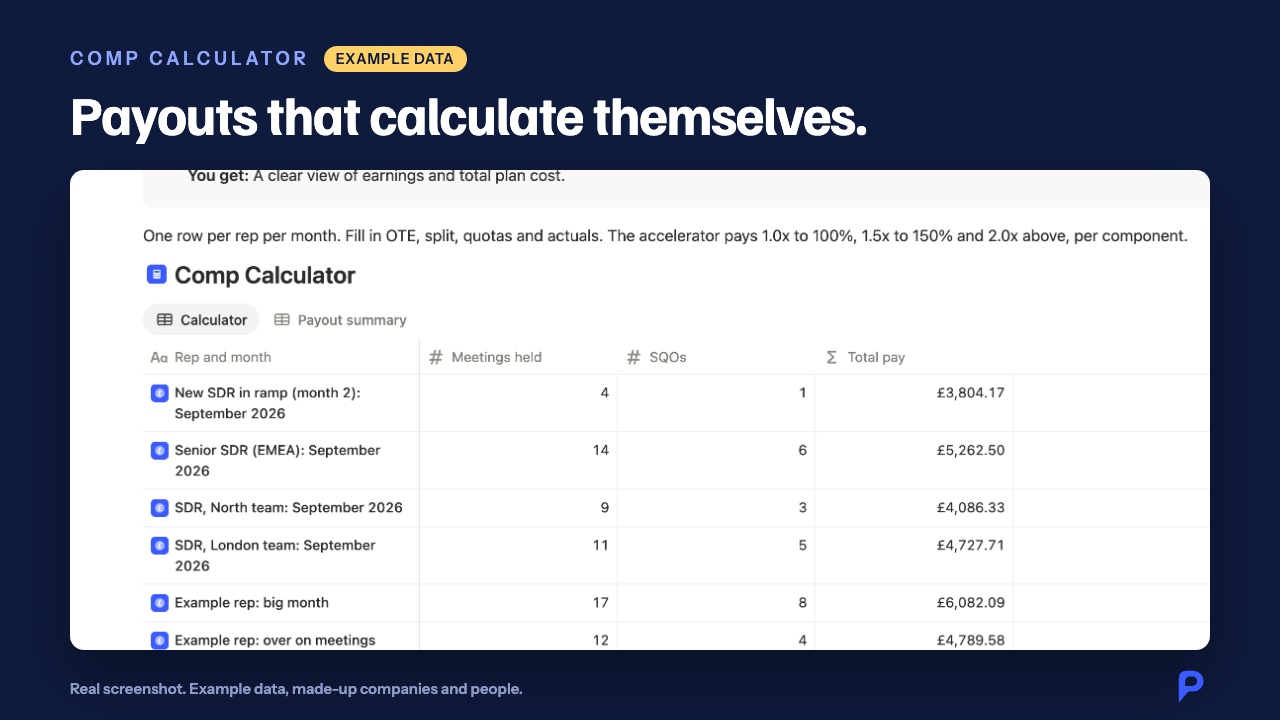
Fernhill puts all variable pay on SQOs, with a target of £1,200 a month. It uses the same accelerator tiers as our free SDR comp plan calculator. That is 1.0x up to 100% of quota and 1.5x from 100% to 150%. Above 150% it is 2.0x.
| SQOs in the month | Attainment | Variable paid |
|---|---|---|
| 4 | 57% | £686 |
| 7 | 100% | £1,200 |
| 9 | 129% | £1,714 |
| 12 | 171% | £2,614 |
Run your own numbers before launch. Would a rep at 171% earn more than finance expects? Decide now whether you want a cap. Don't wait for the month it happens.
Ramp the quota for new reps
New SDRs should not carry a full quota in month one. The Bridge Group's 2025 report puts average SDR ramp time at 3.0 months. The SDR ramp quota calculator works out the monthly numbers. A simple pattern is no quota in month one and about half in month two. Then about three quarters in month three and full quota from month four. Adjust it to your own ramp data. Our SDR ramp time and onboarding guide has a full 30/60/90-day plan.
Take ramping reps out of your capacity maths too. In the Fernhill example, say one of the three SDRs is in month two. The team then has roughly 2.5 reps of capacity, not 3.
Review the quota every quarter
Check four things each quarter:
- Share of reps at quota. If it stays well below 60% to 70%, fix the maths or the lead supply.
- Meeting to SQO conversion. If it falls, check meeting quality and definitions first. Only then think about raising the meetings quota.
- AE acceptance. A rising rejection rate usually means SDRs are chasing the number with weaker meetings.
- Pipeline against the AE target. The quota exists to fill the AE pipeline. Is pipeline short while SDRs hit quota? Then the quota is too low or measures the wrong thing.
Change quotas at the start of a quarter and explain the maths to the team. Never change the rules mid-month.
Common mistakes
- Copying a benchmark quota without checking it against your own funnel.
- Setting quota per rep before agreeing what counts as a meeting or an SQO.
- Paying a heavy share of variable on closed-won deals the SDR cannot control.
- Forgetting ramping reps, holidays and empty territories in the capacity maths.
- Raising quota because the team hit it once, without checking the AEs needed more pipeline.
The SDR Programme Playbook (£29 + VAT) puts all of this in one Notion workspace. You get the definitions and the SLA between SDRs and AEs. You also get the comp calculator and a KPI library. Duplicate it and adapt it to your team.
Sources
Questions
What is an SDR quota?
A monthly or quarterly target for the pipeline an SDR creates. It is usually measured in meetings held, sales qualified opportunities or pipeline value. Build it backwards from the pipeline your account executives need.
What is a typical SDR quota?
The Bridge Group's 2025 report puts the global median at 10 first meetings a month. Of those, 6 convert into opportunities. Introductory meeting models run higher (about 16). Fully qualified models run lower (about 9).
What is a good SDR quota attainment rate?
Around 60% to 70% of reps at or above quota is a healthy range. That is our estimate, in line with the Bridge Group's 2025 finding of 60%. Much lower suggests the quota or lead supply is broken. Much higher suggests the quota is too low.
Should SDR quotas be monthly or quarterly?
Monthly suits most SDR teams. The cycle for a meeting or opportunity is short, and reps need quick feedback. Some teams measure monthly but pay quarterly to smooth out a slow month.
How do you set a quota for a new SDR?
Ramp it. A common pattern is no quota in month one and about half in month two. Then about three quarters in month three and full quota from month four. The Bridge Group's 2025 report puts average ramp at 3.0 months.
Also: quota attainment calculator.
Related guides

SDR comp plan calculator
Model payouts with accelerators before you launch the plan.
SDR and BDR KPIs
What to measure, and 2024-2025 benchmarks to sense-check against.

SDR and BDR ramp time
A 30/60/90-day plan, ramped quotas and a certification checklist.
Turn this into a programme you can run
14 Notion modules and 6 working trackers for SDR leaders. KPI library, comp calculator, cadence builder, interview scorecard, tool scorecard and a 90-day roadmap. £29, one payment, plus VAT for UK and EU buyers.
Treat benchmarks as starting points. Tune them to your market, deal size and sales cycle. Every figure shows its source and year.