SDR team structure: ratios, roles and when to add a team lead
Your SDR team structure sets how fast leads get followed up. It sets whether account executives trust the meetings they get. It also sets how much time the manager has to coach. Structure problems often look like performance problems at first. Inbound response is slow. AEs complain about meeting quality. The manager is too busy to run 1:1s. This guide covers the four structural decisions.
SDR (sales development representative) and BDR (business development representative) are the same job at most companies. Everything here applies to both.
Only need pay and outreach? The SDR Toolkit is £12.99 + VAT.Get the playbook
The four structural decisions
- How many SDRs per AE.
- How to split inbound and outbound work.
- How many SDRs per manager.
- When to add a team lead.
Make them in that order. The ratio sets the team size. The split sets the roles. Size and roles together set the management layer.
1. SDR to AE ratio
The Bridge Group publishes the SDR Models, Motions and Metrics report. The 2025 edition covers 351 B2B companies, mostly North American SaaS. It puts the average at 1 SDR to 2.4 AEs. That ratio has held steady since 2018. The most common model is 1 SDR to 2 AEs, used by 31% of companies. Smaller companies tend to deploy more SDRs per AE.
In the same report, 82% of companies align SDRs to AE territories. That is up from 56% in 2018. Inbound-only teams are the exception. Only 40% of them align SDRs to AE territories. Their leads usually arrive in a shared queue.
To pick your ratio, start from the pipeline your AEs need from sales development. Use the benchmark only as a check. Say each AE needs four SDR-sourced opportunities a month. A ramped SDR creates seven. Then one SDR can support roughly two AEs.
Signs your ratio is wrong:
- Too few SDRs: AEs prospect for themselves and inbound leads wait. SDRs hit quota while AE pipeline is still short.
- Too many SDRs: AEs reject or reschedule meetings and held meeting rates fall. SDRs compete for the same accounts.
2. Inbound vs outbound split
There is no reliable public benchmark for how many SDRs should work inbound versus outbound. So treat the split as a design choice. Three common models:
| Model | How it works | Works best when |
|---|---|---|
| Pooled | Every SDR works both inbound leads and outbound accounts | The team is small (under about five reps) and inbound volume is modest |
| Specialised | Separate inbound and outbound SDRs, often with separate quotas | Inbound volume is high and speed to lead matters, or outbound needs deep account research |
| Inbound as a starting role | New hires start on inbound, then move to outbound once ramped | You hire mostly early-career reps and want a clear progression |
The main risk in pooled teams is that inbound always wins. A warm lead feels more urgent than a cold account. So outbound work shrinks without anyone deciding it should. If you pool, protect outbound time in the calendar. Track inbound and outbound pipeline separately.
The main risk in specialised teams is uneven workload. Inbound volume swings with campaigns and seasons, while outbound capacity is fixed. Agree in advance who covers inbound when volume spikes, and how that affects quotas.
Whatever you choose, set separate quotas or at least separate measures for inbound and outbound. Their conversion rates are very different. Our SDR comp plan guide covers how to weight pay across both.
3. Manager span of control
The Bridge Group's 2025 report puts the average at 6.4 SDRs per first-line leader. That is down from 8 in its 2021 to 2023 editions. 43% of companies have 7 to 9 SDRs per leader. The ratio rises with company size. It is 3.6 at companies under $5M revenue and 8.1 at those above $500M.
Here is a quick capacity check. A first-line SDR manager typically needs, per rep, per week:
| Activity | Time per rep |
|---|---|
| 30-minute 1:1 | 30 minutes |
| Preparing a call review | 15 to 20 minutes |
| Pipeline and lead issues | About 15 minutes |
| Total | About 1 hour |
These are our estimates. At eight reps, that is a full working day each week. Hiring, forecasting, reporting and meetings with sales leadership come on top. At twelve, coaching quietly stops. Taking over a team? Our SDR manager first 90 days guide covers how to protect coaching time.
See inside
4. When to add a team lead
A team lead is usually a senior SDR who keeps part of a quota. They take on some coaching and team operations. It costs less than a second manager. It also gives strong reps a development path besides becoming an AE.
Add a team lead when two or more of these are true:
- The manager has more than about eight direct reports. That is our estimate, in line with the Bridge Group span data above.
- Weekly 1:1s or call reviews are being cancelled more often than they happen.
- You are hiring several new SDRs in the same quarter. Onboarding is falling on one person.
- You run separate inbound and outbound teams that need day-to-day attention.
- A strong SDR wants to lead people but no AE seat is open.
A team lead typically runs onboarding for new hires and leads the weekly team call review. They cover 1:1s for a subset of reps and own the lead queue or routing rules. Their own quota drops, often to around half. That figure is our estimate. Set it to the time the role really takes.
The manager keeps hiring decisions, performance management, comp plans and quotas. They also keep the relationship with sales leadership.
Has the team grown to roughly two team leads' worth of reps? Then plan for a second manager rather than a third team lead.
A worked example
Northgate Cloud is an invented B2B software company. It is planning its sales development team for next year.
| Input | Value |
|---|---|
| AEs next year | 10 |
| Target ratio | 1 SDR to 2 AEs |
| SDRs needed | 5 |
| Inbound leads a month | Enough for about 1.5 SDRs |
| Model chosen | 2 inbound SDRs (one starting role), 3 outbound SDRs |
| Manager span | 5 SDRs: one manager, no team lead yet |
In the second half of the year Northgate plans to grow to 14 AEs. At 1 to 2, that is 7 SDRs. The manager would then have seven direct reports, two of them new. Northgate promotes its strongest outbound SDR to team lead at that point, on half a quota. The team lead runs onboarding and covers 1:1s for the two new hires. If the team grows past about ten, Northgate will split into inbound and outbound teams. Each gets its own manager.
Common mistakes
- Copying a ratio from a benchmark without checking the pipeline maths.
- Pooling inbound and outbound with no protected outbound time.
- Adding SDRs without adding management capacity.
- Making a team lead a title with no time set aside for the work.
- Restructuring mid-quarter, which disrupts territories, quotas and pay at once.
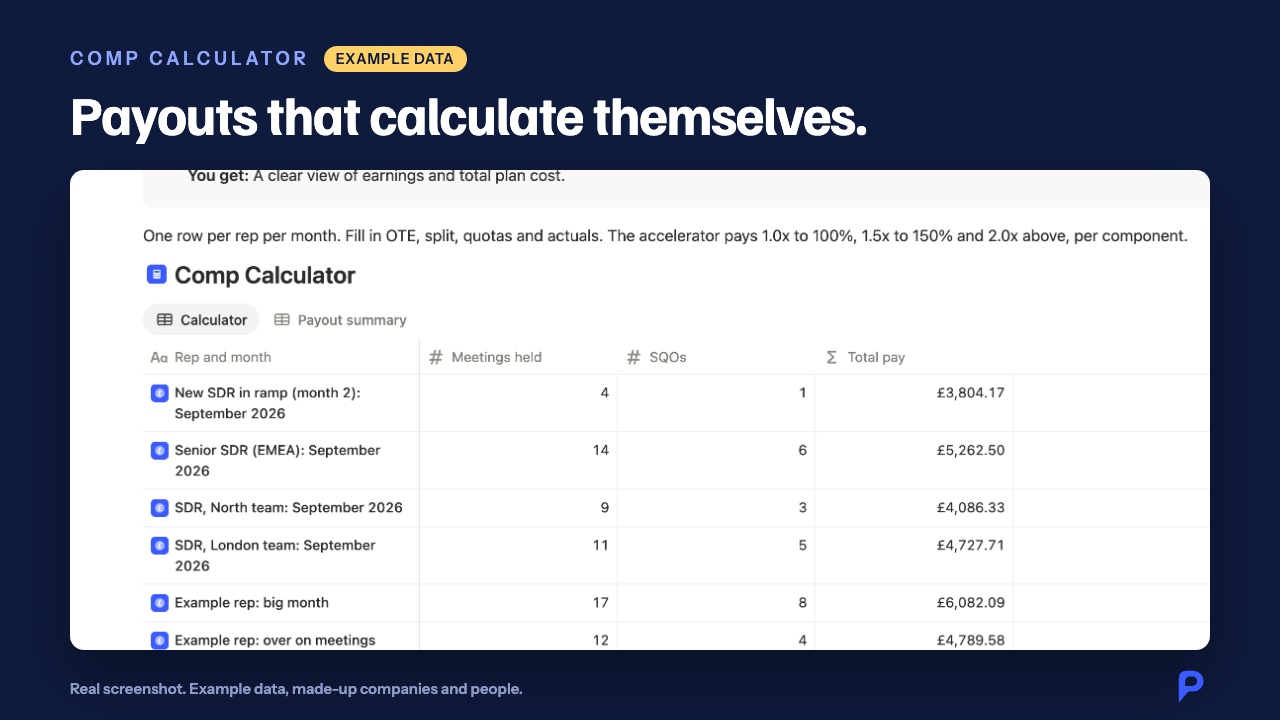
The SDR Programme Playbook (£29 + VAT) is one Notion workspace for a team like this. It holds the territory rules, SLAs, comp calculator and KPI library. Duplicate it and adapt it to your team.
Sources
Questions
What is a typical SDR to AE ratio?
The Bridge Group's 2025 report puts the average at 1 SDR to 2.4 AEs. That has held steady since 2018. The most common model is 1 SDR to 2 AEs (31% of companies). Smaller companies tend to have more SDRs per AE.
How many SDRs should one manager have?
The Bridge Group's 2025 report puts the average at 6.4 SDRs per first-line leader. 43% of companies have 7 to 9. Beyond about eight, weekly coaching becomes hard to sustain without a team lead (our estimate).
Should SDRs work inbound and outbound?
Small teams often pool both. Inbound then tends to crowd out outbound unless outbound time is protected. Larger teams or high inbound volume usually justify separate inbound and outbound roles with separate measures.
What does an SDR team lead do?
A team lead is usually a senior SDR with a reduced quota. They run onboarding, lead call reviews and cover some 1:1s. Hiring, performance management, quotas and pay stay with the manager.
Should SDRs report to sales or marketing?
Both work. Reporting into sales usually tightens alignment with AEs and territories. Reporting into marketing can suit inbound-heavy teams. Either way, write an SLA between SDRs, AEs and marketing.
Also: SDR job description template, SDR capacity planner, SDR manager compensation plan, SDR playbook template for SaaS, SDR vs BDR.
Related guides

SDR manager first 90 days
Learn, stabilise, improve: a week-by-week plan for new managers.

SDR and BDR comp plans
OTE benchmarks for the UK, US and Europe, and how to design the plan.
SDR and BDR KPIs
What to measure, and 2024-2025 benchmarks to sense-check against.

SDR vs BDR
What the titles mean, where companies differ and which to use.
SDR to AE ratio calculator
How many SDRs and team leads your AEs need.
SDR manager compensation plan
OTE benchmarks, the usual split and what to pay on.
Turn this into a programme you can run
14 Notion modules and 6 working trackers for SDR leaders. KPI library, comp calculator, cadence builder, interview scorecard, tool scorecard and a 90-day roadmap. £29, one payment, plus VAT for UK and EU buyers.
Treat benchmarks as starting points. Tune them to your market, deal size and sales cycle. Every figure shows its source and year.