SDR performance review: the metrics to rate and how to run it
SDR performance reviews tend to fail in one of two ways. Some read out the quota report, which the rep sees every week anyway. Others discuss attitude with no numbers at all. That feels unfair to a rep who hit their target. A useful review rates a small set of results, skills and behaviours. The rep knows the standards in advance. Every rating has evidence behind it. The review ends with two or three things to work on next.
SDR (sales development representative) and BDR (business development representative) are the same job at most companies. Everything here applies to both.
Only need pay and outreach? The SDR Toolkit is £12.99 + VAT.Get the playbook
How a review differs from a 1:1
The weekly 1:1 is for coaching. It covers this week's numbers, one or two calls and one thing to try. The performance review looks at a full quarter or half-year. It rates performance against a fixed standard. It feeds decisions on pay, development and promotion. Nothing in the review should surprise the rep. If it does, the 1:1s missed something.
Run reviews quarterly for SDRs. The Bridge Group's 2025 SDR report found average SDR tenure of 1.9 years. An annual review would cover only one or two cycles of a rep's tenure.
What to rate: four areas
| Area | Suggested weight | What to measure | Evidence |
|---|---|---|---|
| Results | 50% | Attainment against quota over the period, on held and accepted meetings or opportunities | CRM report |
| Pipeline quality | 20% | AE acceptance rate, meeting to opportunity conversion, pipeline value created | CRM report, AE feedback |
| Skills | 20% | Research, opener, discovery questions, objection handling, written outreach | Two or three recorded calls and emails, scored on the same rubric |
| Behaviours | 10% | CRM hygiene, follow-up speed, contribution to the team | Spot checks, peer and AE comments |
The weights are our suggestion. Results carry half the score. A rep who consistently hits quota cannot fail the review. The other half rewards the things that make results repeatable.
Keep activity counts out of the rating. Use them for coaching. Rating dials rewards busy work. Our SDR KPIs and benchmarks guide explains the difference between leading and lagging metrics.
A simple rating scale
Use four points. With five, the middle option becomes the default.
| Rating | Results | Skills and behaviours |
|---|---|---|
| 4: Exceeding | Above 110% of quota on average | Could teach this to others |
| 3: Meeting | 90% to 110% | Consistent, with occasional gaps |
| 2: Developing | 70% to 90% | Clear gaps, improving |
| 1: Below | Below 70% | Not yet at the standard |
Set the result bands before the period starts and share them with the team. The Bridge Group's 2025 figure is around 60% of reps at quota. Calibrate to that, and most of the team should land on 3 for results.
Worked example
Marlow Lane Software is an invented company. At the end of the quarter, it reviews Priya, an SDR eight months into the role.
| Area | Weight | Evidence | Rating | Weighted |
|---|---|---|---|---|
| Results | 50% | 94% average attainment over three months (88%, 97%, 98%) | 3 | 1.50 |
| Pipeline quality | 20% | 91% AE acceptance; meeting to opportunity conversion up from 52% to 61% | 4 | 0.80 |
| Skills | 20% | Strong research and opener; discovery questions stay on the surface | 2 | 0.40 |
| Behaviours | 10% | CRM up to date; follow-up within a day | 3 | 0.30 |
| Total | 3.00 out of 4 |
Priya is meeting the standard. The review conversation focuses on one gap: discovery. Her meetings are accepted. But AEs say she rarely uncovers the second problem that makes a deal bigger. Next quarter's goal has two parts. Each handover note records one business problem and one consequence. She also reviews two calls a month with her manager against the rubric's discovery section.
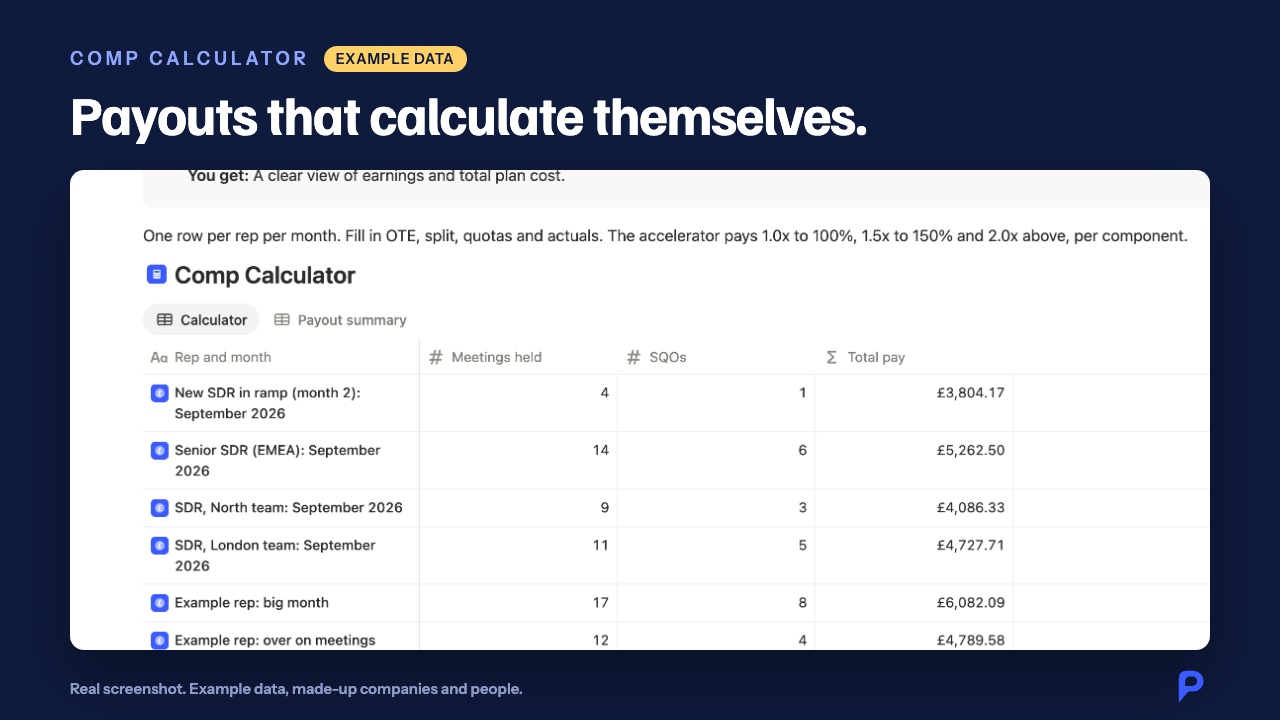
See inside
How to run the review meeting
- Send the scorecard two days before. Ask the rep to rate themselves on the same sheet.
- Start with their self-rating. Where you agree, move on quickly. Spend the time where you differ.
- Show the evidence. Play the call clip, open the report. Ratings without evidence feel like opinion.
- Agree two or three development goals, each with a measure and a date.
- Close with the career conversation. Where does the rep want to be in a year? What does the next review need to show? If promotion is on the table, use your SDR to AE promotion criteria.
The meeting should take 45 minutes. If it takes two hours, the 1:1s are missing things during the quarter.
When the score is low
A rating of 1 on results for a full quarter needs a written plan. Check the cause first:
- Lead supply or territory. Compare the rep's accounts and inbound share with the team's. A poor patch is a manager problem.
- Ramp. Rate a rep in their first three months against their ramped quota. The Bridge Group's 2025 report puts average ramp at 3.0 months.
- Skill. The funnel may show a clear gap, such as conversations but no meetings. Then set a 30-day skill plan with weekly call reviews.
- Will. If activity has dropped with no other explanation, raise it directly in the next 1:1. Do not save it for the review.
Write down the plan, the measure and the date, and follow your company's HR process. The rep should hear about any problem before the review.
Calibrate across managers
With more than one SDR manager, meet before reviews are shared. Compare ratings side by side. Look for one manager rating everyone a 4. Look for skills ratings that do not match the call evidence. Calibration takes an hour.
Want the review scorecard, rating scale, call rubric and promotion criteria in one place? The SDR Programme Playbook (£29 + VAT) is a Notion workspace you can duplicate and adapt.
Next steps: score a recorded call with the free call review scorecard. Agree the next quarter's goals with the free 30/60/90 day plan.
Sources
Questions
What metrics should be in an SDR performance review?
Rate four things. First, attainment against quota on held and accepted meetings or opportunities. Second, pipeline quality: AE acceptance and conversion. Third, selling skills scored from real calls. Fourth, a few behaviours such as CRM hygiene. Leave raw activity counts out of the rating.
How often should SDRs have a performance review?
Quarterly. Average SDR tenure was 1.9 years in The Bridge Group's 2025 report. An annual review covers too little of a rep's time in the role.
How do you weight results against skills?
We suggest about half on results and half on pipeline quality, skills and behaviours. That way a rep who hits quota cannot fail. The review still rewards what makes results repeatable.
What should happen after a low SDR performance review?
Find the cause first: lead supply, ramp, skill or will. Then agree a written plan with a measure and a date. Review it in weekly 1:1s and follow your company's HR process.
Also: why SDRs leave and how to keep them, SDR call review scorecard, quota attainment calculator, SDR team meeting agenda.
Related guides

Weekly SDR 1:1s
A 30-minute agenda, coaching questions and a worked example.

SDR to AE promotion criteria
Four areas to assess, a scorecard and how to say "not yet".
SDR and BDR KPIs
What to measure, and 2024-2025 benchmarks to sense-check against.
Turn this into a programme you can run
14 Notion modules and 6 working trackers for SDR leaders. KPI library, comp calculator, cadence builder, interview scorecard, tool scorecard and a 90-day roadmap. £29, one payment, plus VAT for UK and EU buyers.
Treat benchmarks as starting points. Tune them to your market, deal size and sales cycle. Every figure shows its source and year.