SDR coaching: a simple framework for first-line managers
Most SDR managers want to coach more. Then the week fills up with forecasts, lead problems, hiring and reporting. Coaching gets whatever is left on Friday afternoon. This guide gives you a small, fixed system in four parts. You get a weekly rhythm and one way to review calls. You also get a quick skill-or-will check and a scorecard that tracks progress.
SDR (sales development representative) and BDR (business development representative) are the same job at most companies. Everything here applies to both.
Only need pay and outreach? The SDR Toolkit is £12.99 + VAT.Get the playbook
Why SDR coaching needs a framework
SDRs are usually early in their careers and ramp quickly. They repeat the same few conversations hundreds of times a month. A small fix to an opener or a voicemail shows up in the numbers within weeks. A bad habit repeats just as often as a good one, so inconsistent coaching costs you.
Span of control is the other reason. The Bridge Group's 2025 SDR report puts the average at 6.4 SDRs per first-line leader. That is down from 8 in its 2021 to 2023 editions. Six or seven reps is manageable only if each hour of coaching is planned. Without a system, the loudest rep or the one furthest behind gets all the time. The steady middle gets none.
The framework in one table
| Part | What it is | Time per rep per week |
|---|---|---|
| 1. Rhythm | Fixed slots for 1:1s, call reviews and team practice | About 1 hour |
| 2. Call reviews | One real call or email reviewed against a short rubric | 15 to 20 minutes of prep |
| 3. Skill or will | A quick diagnosis before choosing how to respond | 2 minutes |
| 4. Scorecard | A monthly score on four to six skills, with evidence | 10 minutes a month |
Times are our estimates for a team of six to eight reps. Adjust to your team, but protect the slots in the calendar first and fill them second.
1. Set a weekly rhythm
A rhythm stops coaching being the first thing cut in a busy week.
| Day | Session | Length | Focus |
|---|---|---|---|
| Monday | Team kick-off | 15 minutes | One priority for the week, one shared skill to practise |
| Tuesday to Thursday | Weekly 1:1 per rep | 30 minutes | Scorecard, one coaching topic, commitments |
| Wednesday | Team call review | 45 minutes | One recorded call played to the group and discussed |
| Friday | Practice block | 30 minutes | Role-play the week's shared skill in pairs |
The 1:1 is where most individual coaching happens. Our weekly SDR 1:1 guide has a 30-minute agenda and a worked example. Keep forecasting out of it. Pull numbers from the dashboard beforehand so the time stays on skills.
The team call review works best when reps volunteer calls, including ones that went badly. Start with your own if nobody offers. At each turning point, ask the group what the buyer was thinking. Do this before anyone suggests a fix.
2. Run call reviews that change behaviour
End each call review with one change. The rep uses it on their next ten calls.
Use the same short rubric every week, so reps learn what good looks like.
| Stage | What good looks like |
|---|---|
| Opener | States who they are and why they are calling in one or two sentences. Gives a reason relevant to the buyer |
| Discovery | Asks at least two open questions. Follows up on the answer before moving to the pitch |
| Value | Connects one specific problem to one specific outcome, in the buyer's words |
| Objection | Acknowledges the objection, asks a question about it and responds once without arguing |
| Close | Asks for a specific time and confirms who will attend and why |
How to run it:
- Pick the call before the meeting. Choose one that shows the skill you are working on. Skip the worst call of the week.
- Ask the rep to score it first against the rubric.
- Agree one strength, named specifically.
- Agree one change, and role-play that moment twice.
- Write the change down as a commitment for next week.
One observation and one suggestion is enough. Five pieces of feedback feel thorough to the manager and overwhelming to the rep.
See inside
3. Diagnose skill or will before you coach
The same symptom, such as low activity or few meetings, can come from very different causes. If you treat a skill problem as a motivation problem, you waste time and lose trust. The same is true the other way round.
| High skill | Low skill | |
|---|---|---|
| High will | Stretch: give harder accounts, peer coaching roles and a view of the next step | Teach: show, practise, review. Most new SDRs sit here |
| Low will | Re-engage: ask what has changed, look at workload, recognition and career path | Direct: set clear short-term expectations and review weekly. If nothing changes, start a formal conversation |
Ask before you place someone. Try "What is getting in the way?" The answer often shows a cause neither box covers. It might be a weak territory, a broken lead list or a problem outside work. Fix those first.
Will can also be a symptom of skill. A rep who keeps getting rejected on the phone may avoid calling. That looks like low effort. If activity drops, review a call before you review the work ethic.
4. Keep a simple scorecard
A monthly skills scorecard gives you a written record of progress. Score four to six skills from 1 to 4, with one line of evidence each. 1 is not yet, 2 developing, 3 consistent and 4 could teach it.
A worked example
Priya is an invented rep in her fourth month at Brightwater Systems, a made-up software company.
| Skill | Month 3 | Month 4 | Evidence |
|---|---|---|---|
| Research and personalisation | 3 | 3 | First lines reference a real trigger in most emails reviewed |
| Opener | 2 | 3 | New opener tested on two weeks of calls, conversation rate up |
| Discovery questions | 2 | 2 | Still moves to the pitch after the first answer |
| Objection handling | 2 | 3 | Handled "send me an email" well in three reviewed calls |
| Booking and confirmation | 3 | 4 | Every booked meeting confirmed on the day, held rate improved |
| CRM hygiene | 3 | 3 | Notes complete, next steps logged |
Discovery is the one skill that has not moved. So discovery is next month's coaching topic, and Priya can see why. The same evidence feeds into promotion decisions later. See our SDR to AE promotion criteria.
Pair the skills scorecard with the activity and outcome numbers from your KPI dashboard. Skills explain why the numbers moved. The numbers show whether the skills are working. Our SDR KPIs and benchmarks guide covers which metrics to track.
Coaching new reps versus experienced reps
New reps in their first three months need more show and less ask. Let them shadow good calls. Have them practise the opener and the most common objections daily. Review a call with them twice a week rather than once. The Bridge Group's 2025 report puts average SDR ramp at 3.0 months. Front-load coaching into that window.
Experienced reps need more ask and less show. Let them choose the coaching topic, bring their own calls and coach a newer colleague. It also tests whether they are ready for a team lead or AE path.
Common mistakes
- Coaching only the reps who are behind.
- Reviewing calls live in the 1:1 instead of preparing beforehand.
- Giving five fixes at once.
- Treating every dip in activity as a motivation problem.
- Keeping no written record, then relying on memory at review time.
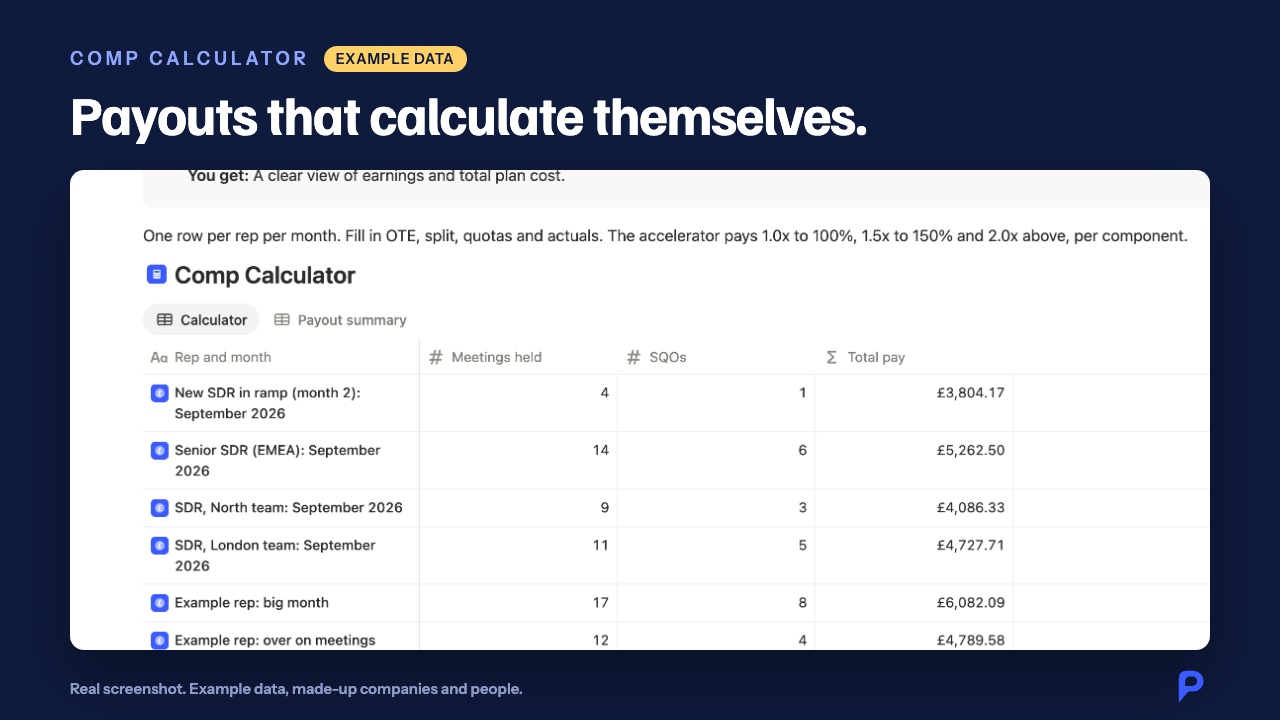
The SDR Programme Playbook (£29 + VAT) sets this up in one Notion workspace. You get the rhythm, a KPI library, call standards and a 90-day roadmap. Duplicate it and adapt it to your team.
Sources
Questions
What is SDR coaching?
SDR coaching is the regular, structured work a manager does to improve each rep's skills. It usually runs through weekly 1:1s, call reviews and practice sessions. It focuses on behaviours the rep can change, not just on the numbers.
How often should you coach SDRs?
Every week. A workable rhythm for most teams is a 30-minute 1:1 and one prepared call review. Add a short team practice session. New reps benefit from a second call review each week in their first three months.
What should an SDR call review cover?
It covers the opener, discovery questions and how value was explained. It also covers how objections were handled and how the meeting was booked. Ask the rep to score the call first, then agree one strength and one change.
What is the skill vs will model in sales coaching?
It is a two-by-two grid. It separates whether a rep can do something (skill) from whether they want to (will). It helps managers choose the right response: teach, stretch, re-engage or direct.
How many SDRs can one manager coach?
The Bridge Group's 2025 report puts the average at 6.4 SDRs per first-line leader. Beyond about eight, weekly 1:1s and call reviews are hard to sustain alone. Add a team lead at that point (our estimate).
Also: why SDRs leave and how to keep them, SDR call review scorecard, SDR daily schedule template, SDR team meeting agenda, free SDR training, SDR performance review.
Related guides

Weekly SDR 1:1s
A 30-minute agenda, coaching questions and a worked example.

SDR to AE promotion criteria
Four areas to assess, a scorecard and how to say "not yet".
SDR and BDR KPIs
What to measure, and 2024-2025 benchmarks to sense-check against.

SDR performance review
What to rate, a weighted scorecard and a worked example.

Free SDR training
A 4-week in-house plan for calls, email and discovery.

Cold call script for fintech
One problem, one question and the checks to run first.
Turn this into a programme you can run
14 Notion modules and 6 working trackers for SDR leaders. KPI library, comp calculator, cadence builder, interview scorecard, tool scorecard and a 90-day roadmap. £29, one payment, plus VAT for UK and EU buyers.
Treat benchmarks as starting points. Tune them to your market, deal size and sales cycle. Every figure shows its source and year.